Research and reading
Average reading speed for adults
Reading pace changes with the text, the reader and the task. Research averages provide context, not personal targets.
What the research reports
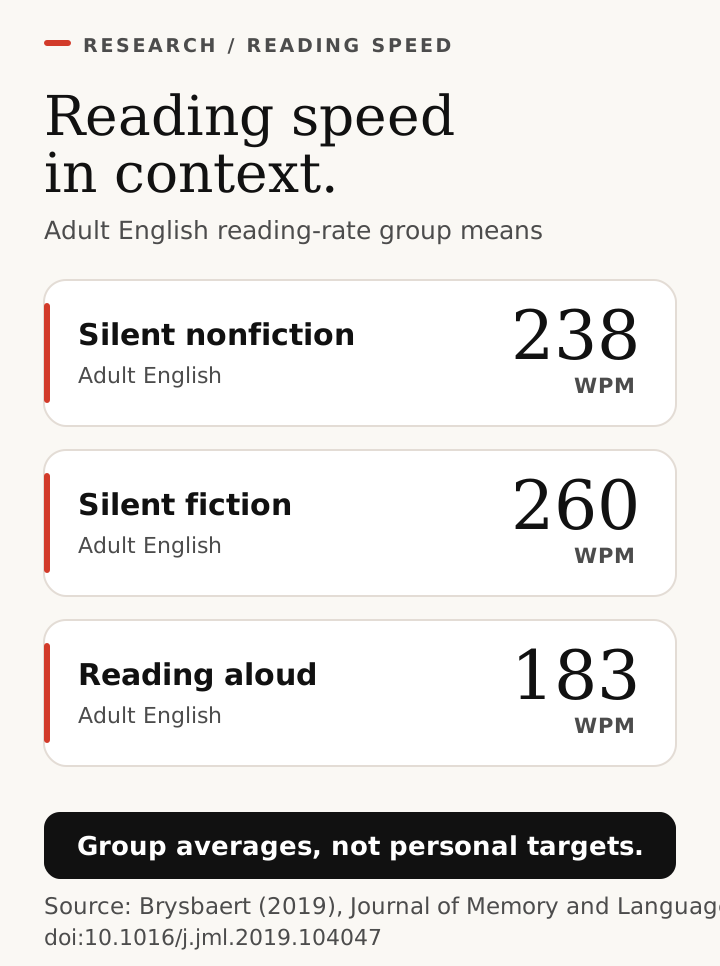
Marc Brysbaert’s 2019 review and meta-analysis reports these average rates for adults reading in English. They describe groups of readers—not what any one reader should achieve. Read the university record and abstract.
| Reading task | Reported group mean |
|---|---|
| Silent English nonfiction | 238 WPM |
| Silent English fiction | 260 WPM |
| Reading aloud | 183 WPM |
The silent-reading results drew on 190 studies and 18,573 participants; oral reading was analyzed separately using 77 studies and 5,965 participants. The review describes most adults reading English nonfiction silently as falling around 175–300 WPM, and fiction around 200–320 WPM. These are descriptive ranges, not confidence intervals, percentiles or pass marks.
Is 200 WPM a good reading speed?
200 WPM is within the reported range for most adults reading English nonfiction silently. That does not make it a pass mark, nor does reading faster automatically mean reading better. The text, your purpose and what you understood matter more than comparing one attempt with a group average.
Why does my pace change?
A familiar story and a dense chapter to study are different tasks. Topic familiarity, vocabulary, interruptions and the need to check details can change how long a text takes. Reading in another language may also give you a different pace.
Use a result from the reading speed test as a starting point, then adjust the reading-time calculator for the material you plan to read. Three eligible readings of distinct informational passages can form the site’s optional median summary—not a standardized ability score. See the methodology for eligibility rules.
Does a speed test measure comprehension?
WPM measures reading pace. A separate five-question check samples how you answered questions about one passage. Neither number is a complete measure of reading ability. Multiplying WPM by a question score would not create a validated combined measure; My Reading Pace reports the two separately.
For open-book questions and answer explanations without a clock, try adult reading comprehension practice.
Limits of averages and speed-reading claims
Brysbaert’s estimates do not validate My Reading Pace’s passages, its optional questions or a personal baseline. The site’s materials are informal and have not been difficulty-calibrated. Read the methodology.
Rayner and colleagues’ 2016 review discusses trade-offs between reading speed and detailed comprehension. Skimming may help find a gist quickly; careful reading may be more suitable when details matter.
Research references: Brysbaert, M. (2019), Journal of Memory and Language, 109, 104047, doi:10.1016/j.jml.2019.104047; Rayner et al. (2016), Psychological Science in the Public Interest, 17(1), doi:10.1177/1529100615623267.