
Comprehension practice
Reading comprehension practice for adults
Choose a passage. Read at your pace, answer five questions and review explained answers. No timer; look back at the text whenever you need to.
A library of useful things
265 words · Informational example
A map that helps
277 words · Informational example
The repair table
281 words · Informational example
Making room in a calendar
278 words · Informational example
The blue envelope
281 words · Fiction
A seat by the window
287 words · Fiction
Friday's order-desk handover
222 words · Workplace email
A room for Maya's interview
220 words · Service comparison
Submitting a photograph
221 words · Instructions
How to use the exercises
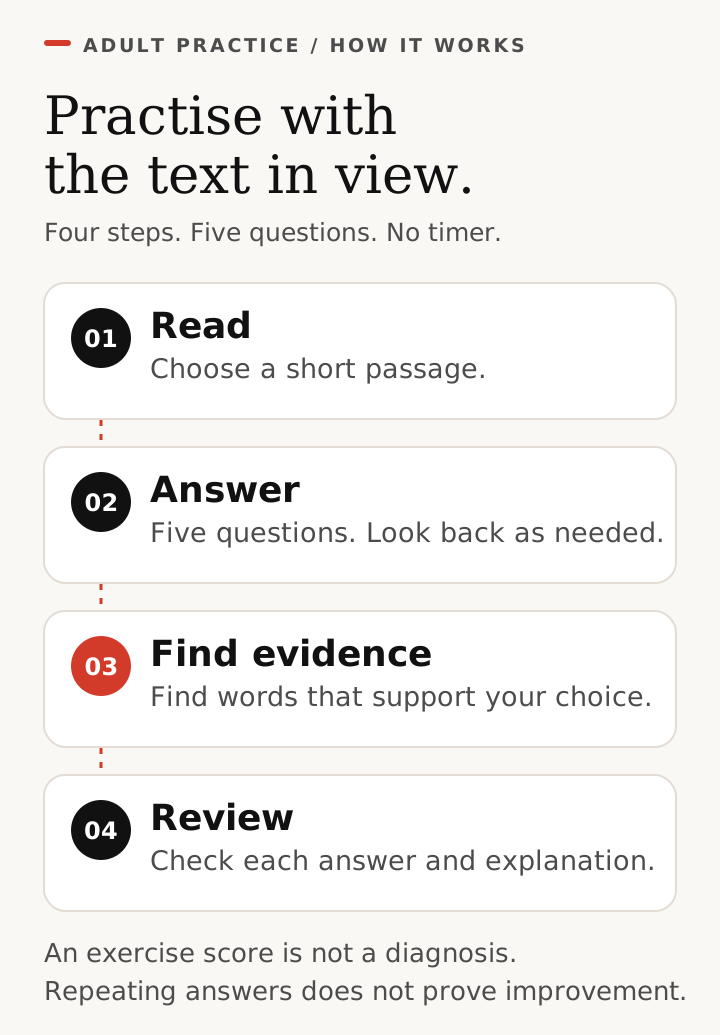
- Read: Choose a passage and read at a comfortable pace.
- Answer: Respond to five questions. Look back whenever you need to.
- Find evidence: Locate a sentence or detail that supports your choice.
- Review: Check the answers and explanations, especially where you were uncertain.
For another check, describe the main point in your own words and find a sentence that supports it. You can also ask why a different answer does not fit the text.
What will the questions ask?
Depending on the passage, questions may cover details, the main idea, inferences or the meaning of words in context. Some answers are stated directly; others require connecting clues. Each question has an answer explanation to review.
For example, imagine a passage says: “Mina put the borrowed umbrella beside the door so she would remember to return it.” If a question asks why she put it there, the supported reason is to remember to return it. The passage does not say that rain was forecast. A believable guess is not the same as evidence from the text.
Practice, not a reading-level diagnosis
These are informal English self-study exercises for adults. Five answers are not a comprehensive reading assessment. The passages have not been calibrated to a CEFR level or as a standardized exam, and a score does not diagnose a reading difficulty or prove improvement.
The exercises were AI-generated and checked by Codex AI for passage-and-answer consistency, not independently human-reviewed or calibrated. Read how the materials were made.
The optional questions after the timed reading speed test start in a different, closed-book flow. Here, you may return to the text whenever you want.
Prefer to work on paper?
Use printable reading practice to print student sheets and separate explained answer keys for your own practice. Keep the My Reading Pace attribution. The current terms do not grant redistribution or resale rights.
Common questions
Are answers included?
Yes. Each passage’s five questions include explanations. Review them after answering, or open the study key deliberately.
Can I practise without a timer?
Yes. These exercises are untimed, and you may refer to the passage while answering.
Does five out of five mean my reading has improved?
It describes how you answered these five questions. Familiarity with a passage can affect a later attempt, so repeating the same score does not establish improvement.
What if an exercise feels difficult?
Return to the passage, identify the clue behind an answer and use the explanation. You can choose another passage; there is no required passing score.
New to the terms? Explore reading comprehension with a worked example.